

GROUNDBREAKING NEW TOAD SUCK HITS THE STREET!!!
SHARKWEEK YEAR
By Mark Spitzer
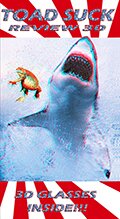
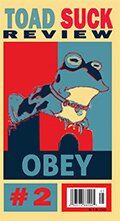
Salutations, Toad-Friends! When we dubbed our last issue “The Year of the Toad” we had no idea that Library Journal would officially recognize us as one of the ten best literary journals of the year. Since this international award, we’ve been rolling in subscriptions from savvy librarians across the land. Usually genius goes unnoticed, but not in this case. We are proud of this honor and intend to surpass what we did in #2 with our brand spanking new third issue, hereby entitled Toad Suck Review 3D!
Regarding our revolutionary front and back covers trailblazing a new trajectory through the History of Publishing with ye olde red and blue technology, they are what they are. I messed around with Photoshop and a tutorial on YouTube, and this is the result. Thank you, thank you, I am also amazed and amused.
More importantly, though, is what these images happen to frame, particularly our flagship piece, “Underground in Amerigo.” This is a monumental lost work by Edward Abbey, which even the most seasoned scholars of the Master Monkeywrencher (aka, Cactus Ed, the Father of the Modern Environmental Movement, etc.) don’t know jack about. I originally found this essay twenty years ago, buried in a pile of old moldy mimeo mags at the mythic bookstore Shakespeare & Company in Paris, France. It was in a forgotten quarterly called Accent, published in 1957, which I immediately sent to my friend the Abbey expert Ken Wright in Durango, Colorado, who was an editor for a weekly newspaper called Inside Outside. Ken got permission from Ed’s widow Clarke Abbey and republished this piece in 1999. Then it became lost again. Until now—thanks to Clarke, who granted the Toad (so therefore the world) the opportunity to see this great narrative in print once more!
Our groundbreaking 3D issue is therefore an extremely eco-issue, since we’ve also got Gary Snyder on board, as part of our feature on the literally lost Beat poet Lew Welch, who took a walk in the woods one day and never came back. We’re glad to have some literary criticism of his which also went astray for years, and we’re grateful to City Lights in San Francisco for granting us permission to republish this work in our Critical Intel section. But we’re also proud of the rest of our Eco Edge section—like Emily Eddins’ provocative portrait of Reno, NV and Truckee, CA, and Brent House’s postmodern pastorals, whose line breaks were so elongated that we had to flip the poems to make them fit.
Another theme in this issue is our pumped-up Arkana section. We have a phantasmagoric flash from Tyrone Jaeger’s dream-universe, and some sparkling gems of vital verse straight from the brainwaves of Sandy Longhorn. Chris Shipman and Jay Levon are visual cartographers of our geographic imagination, and Dennis Humphrey provides some fiction with characters as colorful and tragic as the state of this fracking state.
Heather Cox, however, is an exception. A native of Hot Springs, she sports a review in Critical Intel, but we’ve also injected her in with our High-Octane Poets, due to the appropriateness of her whacko mole-people poems―which complement Ben McClendon’s vast and curious galaxy of sundry funtastic poetic forms. But behold as well the Legendary Laureate Antler, who always blips brilliantly on our radar. As do Drea Kato and Molly Kat, whose really real situations become hyper-imagistic modes of momentum when rendered strophicly. Mark DeCarteret and Tracy Thomas have also got it going on in the isotope of inertia as they propel Poetix to new limits. As for Brad Johnson, how can you beat the killer effect of those last two lines of his first poem? Beautiful!
But now let’s head for Creative Nonfixion, where a sophisticated memoir of Xu Xi provides currency for currency, and Jesse Glass makes us laugh with profiles of pretentiousness. Then there’s our own Rex Rose, who’s been with us from the get go. At first he was our Design Editor, and then he was our Webmaster, but due to a recent evolution, he is now a contributor―so check out the excerpt from his punk-ass past.
Concerning the recent evolution just referred to: The Arkansas Writers MFA Program has just been launched at UCA, thereby supplying us with a bevy of new editors. Assistant Editor Scotty Lewis is one of these and is webmastering our online presence at toadsuckreview.org, where you can see a whole bunch of new online content, selected and edited by the pioneers of the most nouveau and promising grad program in creative writing on the planet. John Mitchell is another Assistant Ed, and we’ve got him cranking on a multitude of top secret tasks. The rest of the editorial staff includes Jobe (yes, one word), Stacey Margaret Jones, Louie Land and Lynne Landis. Plus, we’ve got Chris Hancock of 4.AD.PPL promoting the Toad quite cyberly. Anyhow, we’re always looking for MFA applicants, and support is available. The ad in the back can tell you more, or visit uca.edu/writing/mfa.
Meanwhile in Crititcal Intel, we have some very user-friendly art criticism from the iconic poet Gerald Locklin, who we met at the AWP and solicited with vigor. Then there’s Mark Jackson’s scholarly article on John Lomax and some highly celebrated blues legends, complete with some really cool photos, compliments of the Library of Congress. Add to this the elusive reviewer C. Prozac, the much more tangible Skip Fox reviewing a surreal text from the netherworld of Illinois, and the already mentioned Lew Welch feature, and this section is complete.
In Fixion we have the strangely deranged prose of Larry Lefkowitz, who our Associate Ed John Vanderslice described as “word drunk” when he found it raving in our inbox. It intoxicated us as well, as did the semi-disturbing-but-action-packed story by Devin Murphy and the bizarro-yet-subtle quasi-omniscience of Peter Liu.
Holy Guacamole! We’ve also got Masterbard Ed Sanders in our Artists-in-Residence Feature! Talk about a Beat Superstar! Talk about us being lucky! Talk about an interview―conducted by the editorial staff of the Toad Suck Review!
We also have a new translation from Jean Genet, never traduced nowhere before & expertly at that by Andrew Hill! I’m telling you, people, this Toad Suck is packed with Historic Stuff! Witness also the texting translations of Just Kibbe, the Georgian poet Zviad Ratiani as interpreted by Dailila Gogia and Timothy Kercher, and Margarita Meklina from St. Petersburg decoded deluxly by Krystyna Steiger. This is one hell of an international issue! We’ve got artists here from all across Asia and Arabia, from Canada and France, from Russia and America, from Israel and the grave.
Ultimately, though, check out Fred Petrucelli, whose history of Toad Suck provides perspective on the infamous name of place we embrace. We at TSR are honored that Yahoo News voted Toad Suck the “most unfortunate town name” in America, with Climax, Georgia and Boring, Oregon nipping at our heels.
That said, we’re still offering ad space ($50 for a half page, $100 for a full page) and we’ll design those ads if you like―like the one in here for Ahadada Books. But one more thing before we go, Beloved Toadsters: Please know that we appreciate your thirst for cutting-edge lit that doesn’t suck. Without your great taste, there’d be no demand for our supply. So here’s to you, whose spirit is ablaze in the hugest, most-eco, most-3D Toad Suck Review to ever challenge the status quo!
Image courtesy of Gustav Carlson.
Books Received
25 Sightings of the Ivory-Billed Woodpecker. Re’lynn Hansen. Firewheel Editions. Hansen’s chapbook is a well rendered blend of eco-poetics and straightforward journalism centered on the slow but inevitable extinction of the ivory-billed woodpecker. She unflinchingly exposes our human impulse to possess rather than preserve rare and endangered creatures in the disappearing wild lands of North America.
The Dichotomy Paradox. Brad Johnson. Longleaf Press. Johnson’s poetry is an immersion into the subtleties of everyday life. It is a study of found objects and abandoned ideas. Johnson has a keen eye for the frictions between loss and discovery that emerge naturally with the passage of time. He finds us as we are “separated by an infinity of fractions.”
Hanoi Rhapsodies. Scott Ezell. Empty Bowl Press. Musical, precise, haunting. Ezell shows us the poet being eaten by the sprawl and industry of the modern world, where resilience and survival become a matter of adaptive mutation. Reading Ezell evokes the sensation of jumping dream-ward into a sausage grinder and emerging almost whole.
How to Kill Poetry. Raymond Luczak. Sibling Rivalry Press. Luczak has a wild, experimental style. He channels myriad poetic voices and characters: Sappho, Arthur Rimbaud, Walt Whitman, Gwendolyn Brooks, Sylvia Plath, Allen Ginsberg, Adrienne Rich … even the invented futuristic musings of Roland Rieves. Through his work, Luczak ties the possible decline of poetry to our seemingly diminishing interest in revolutionary art. He describes “Writing a stanza” as “an act of sabotage.” Despite the dilemma that his title suggests, Luczak is laboring to keep poetry alive.
Book of Knut: A Novel by Knut Knudson. Halvor Aakhus. Jaded Ibis Press. The Book of Knut is a collage of personalities and eclectic interests. Conversations morph into mathematical equations. Musical scores mark the moods and rituals of working in commercial kitchens. The narrative constantly evolves and branches out into surprising territory. It stands as a fluid observation of an engaged and curious mind.
Monkeytown. Chris Vola. S A M Publishing. Vola creates a dystopia born from our culture’s voyeuristic fascination with violence and death. Conspiracy theories and charismatic thugs thrive in a world where the manipulation of public opinion is more valuable than human life. The only available escape seems to be an immersion into the mind-altering consciousness of pharmaceutical cocktails. Monkeytown is a frightening vision of what we might become.
Stoning the Devil. Garry Craig Powell. Skylight Press. Garry Craig Powell’s novel in stories Stoning the Devil grips the reader from page one. The collection is a hard-hitting, ambitious work of fiction with an overarching thematic plot progressing from story to story. The structure of the book is like viewing an elaborate mosaic of interrelated texts and examining each exquisite piece in detail until an intricate picture is apparent. Stoning the Devil is set in the Middle East and primarily occurs in the United Arab Emirates. Most of the characters are Islamic and of Middle Eastern origins. The novel tells of their heartaches and struggles as they live in and even find success after the wars that set them as refugees early in their lives.
The novel begins with the titular story, a letter written by Badria, a fifteen-year-old girl from Dubai, telling of the horrors she has faced and how she refuses to accept them as facts. She makes up elaborate fantasies drawing upon the folklore of the area to blame sexual assault and other crimes on jinn. This sets the tone for the rest of the book as more details are seen from the eyes of surrounding characters and the full nature of her story and the lie she tells herself and others becomes more and more apparent.
Stoning the Devil is well-crafted and provocative. Powell’s bold move of showing a sympathetic look of the day-to-day lives of characters living in the Middle East stirs empathy for the conflicts abroad while casting a subtle, but interesting point about the politics that cause these wars. This futility and the struggle for salvation from it comes to a head in the story “The Moving Crucifixion,” wherein Marwan, an investment banker in his thirties realizes his marriage with his wife Randa is falling apart and begins a search for another love.
Powell’s true genius is his subtlety of metaphor and light touch with the senselessness of traditions that are long outdated. Powell takes a definitive stance on the situations facing the Middle East without preaching or browbeating participants. The tension between rationality and tradition, the old ways and the new creates a delicate dance of interwoven metaphors that will captivate any reader. This is especially apparent in the female characters Powell has created. None of the women in the novel are wholly submissive as the traditions require and the delicate balance between asserting themselves and being socially acceptable is at once beautifully provocative and unsettling. Fayruz, the main protagonist of the story “A Woman’s Weapon,” illustrates this by using her sexuality to gain power over her husband and other men in her life.
The characters in Stoning the Devil are as real as any could be in the whole of literature with flaws that make them entirely human. The female characters are especially thought-provoking. The psychological nature of repression and the reactions to impression make every tale in Stoning the Devil unique while maintaining a cohesive narrative.
New and Selected Poems. Gerald Locklin. World Parade Books. This is an extensive collection of compelling poems from the prolific Locklin. Some new works are included along with others previously published in a variety of reviews nationwide. These poems are highly readable on a wide range of topics with a chronological arrangement that allows the reader to trace Locklin’s voice and vision across four decades.
Alone with the Terrible Universe. Alan Britt. Cypress Books. This book showcases great poetic dexterity and range. Britt tackles the world at war with a passionate ferocity that is both disconcertingly grounded and hauntingly surreal.
The Vampires Saved Civilization: New and Selected Prose, 2000-2010. Gerald Locklin. World Parade Books. In the foreword to Gerald Locklin’s The Vampires Saved Civilization, Dave Newman writes, “imagine a sort of mash-up of Donald Barthelme and Ernest Hemingway, weird when weird is the only way to explain the world, living a man’s life because it’s the only life for a man to lead.” The many stories in Locklin’s collected work are short, offering quirky, unique glimpses at moments. Like a spare trumpet line by Miles Davis, Locklin is concise, telling a story in as few words as possible, yet the trumpet line is a line from Bitches Brew, the sound an odd shade or color, Davis’s horn warped by a wah-wah pedal. Your ears perk as the sound echoes and fades. Similarly, Locklin’s voice and unique insights startle you, and you lean forward to catch sight of the spark before it’s gone.
Super Cutey. Vox Anon. Lulu/Amazon. Super Cutey by Vox Anon is a self-proclaimed “collection of sugary sweet visions, dreams, peek a boos, & taboos.” It’s full of freshly voiced images that speak to the reader, to all the readers in such a personal way that you’d almost swear they were taken from your own mind. Non-traditional and inspired they challenge the reader to read deeply and then to read again.
The Infinite Atrocity. Kane X. Faucher. Civil Coping Mechanisms. This book exlpores “the inner cruelty of humanity given flesh and crooked new reason.” In the words of his fictional psychoanalyst, Dr. Edward Albrecht, “Art is built for atrocity.” Faucher proves it.
Sky*Boat: Poems and Collages. Ronnie Burk. Kolourmeim Press. Burk’s final manuscript, published post-humously by close friend and long-time editor Mia Kirsi Stageberg, Sky*Boat is a fearless journey through poignant syntax and celestial, anatomical imaginings. Surrealist poèsie built from powerful, unrepentant language is punctuated by strange and striking visual images. As Burk advises in his Surrealist Proverb, we ought to, “sweep the laundry, fold the floor, cook the window, bake the door.” And read this book.
How I Never Learned To Stop Worrying And Love The Bomb, Or, In The Belly of The Whale: Some Prose On PTSD, With Poems Selected From The Deep Sea Journals Of STS3(SS) Wilfred “Willy” Brathwaite. Wilfred Brathwaite. Ecolinguistics 2.0. Through the entries in his chapbook, Brathwaite offers a glimpse into the nearly psychotic and paranoid mindset of life and military service in the 1980s. He surrealistically elucidates the character of fatalistic Cold War bravado, “President Reagan is a cowboy, talking up Star Wars and joking over the radio about bombs falling in five minutes. It is a period of genuine yahoo, psychological brinkmanship”
Sheer Indefinite. Skip Fox. University of New Orleans Press. Fox’s poems hit the reader like a tornado of sensual images, “As though,/ spinning off, he might collide/ with the self returning from the peripheries of circumstance, a corpse/ fresh from the void crowded/ with event…” It seems impossible to read Sheer Indefinite without randomly being struck by Fox’s sincerity and perception.
Insane In The Quatrain. Bradley Lastname. The Press of the Third Mind. Readers may not find many quatrains in Bradley Lastname’s book, but they will playfulness that the title suggests. It’s a “hodge podge sweat lodge” of inventive observation and word play. The poet’s myriad themes and voices are held together by his sharp, irreverent sense of humor. In one poem, he even dares to channel the voice of Mike Tyson to chew over the ear incident with Evander Hollyfield. If you approach this book with an open mind and a sense of humor, you’re bound to have a good read.
The Laurel Review. John Gallaher and Richard Sonnenmoser, eds. Green Tower Press. This biannual literary journal, published by the Department of English & Modern Languages of Northwest Missouri State University, delivers a well- balanced collection of poetry, fiction, essay, and book-reviews. Voices and styles featured in The Laurel Review are always diverse, rich, and worth reading.
Romeo’s Ugly Nose. Chris Shipman and Benjamin Cockfield. Allography Press. This book is an excellent collaborative blend of art and poetry. Shipman and Cockfield place Shakespeare’s star crossed lovers in the 21st century. They stumble in and out of bars; whisper to each other in text messages. “This Juliet is/ hung crooked – a framed city/ of lame unsung love” and Romeo “still harbors her/ absence in the river in his head.”
